By Cathy Jones (updated 2024, 2025)
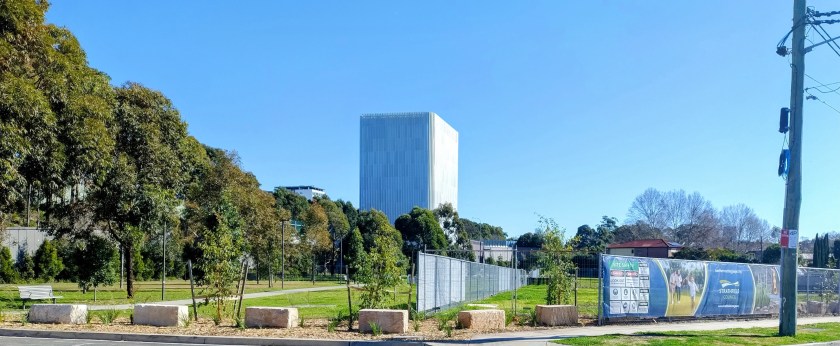
The area of Powells Creek Corridor contains a number of existing parks (Arnotts Reserve, Allen Street Reserve and Ismay Reserve). Other areas of open space are connected to this large corridor of land, which runs close to Powells Creek.
The Wangal Aboriginal people inhabited what is currently known as the Strathfield Local Government Area (LGA) for thousands of years prior to European settlement in the 18th century. The Wangal people held a deep connection to the land and landscape of the Strathfield area and utilised the natural resources of the area, living off the land and local waterways through fishing, hunting, and gathering. By the late-1800s, much of the land and landscape in Strathfield was cleared for development of housing, roads and railways to facilitate growing populations. Increasing urbanisation resulted in many Wangal people moving away from their land in the Strathfield area.
The majority of the land in the Powells Creek Corridor was granted to Thomas Rose in 1798 by a Crown Land grant. The land transferred to Edward Powell (whom Powells Creek is named) and then sold to his son-in-law James Underwood (who Underwood Road is named) in 1823. Underwood owned significant lands in the Homebush district on both sides of the railway line, which were surveyed and subdivided c.1878-1880.
The land north of the western railway line (including Homebush Station) was subdivided c.1880 and created the street layouts which are largely still in place. Streets such as Underwood Road, Powell Street, Wentworth Road and Creek Street (now Pomeroy Street) were laid out at this time.
Homebush Council, which included land north of the rail line and bordered at east by Powell’s Creek, was incorporated in 1906. The first Sands Directory in 1908 notes development on Underwood Road and Pomeroy Street, mainly houses. Streets including Short Street, Ismay Avenue and Allen Street were created in the 1920s through further subdivision. Residential development commenced in the late 1920s in these streets.
In the early 1930s Powells Creek was concreted as a stormwater canal and the natural boundaries of the river were altered and straightened. As land abutting Powells Creek were prone to flooding, it remained undeveloped, though early market gardens were established near the Creek, which was later dedicated as open space. This linear land corridor contains sites owned by Strathfield Council, Sydney Water and Ministerial Planning Corporation (NSW Government Agencies).
The land on which Allen Street Reserve is located was transferred by the Cumberland County Council to Strathfield Council in 1957 for a public park and recreation area.
Two community facilities were built at 26-28 Pomeroy Street in Ismay Reserve. The former Homebush Bowling Club was built in 1963 and Shapiro industries c.1964. The former Club building is not currently in use and the former Shapiro Industries building is used by Strathfield Mens’s Shed.
Part of Arnotts Reserve and 20 Parramatta Road (north of Parramatta Road) are located on the 1799 Thomas Rowley land grant, which totalled 750 acres and includes parts of current day Burwood and Strathfield. By 1928, the land on which Arnotts Reserve is built was owned by biscuit manufacturer William Arnotts, who operated a biscuit factory on the eastern side of Powells Creek. The Reserve was connected to the factory by a bridge and the land used for staff recreation which included a lawn bowling club. Ownership of the land was transferred to Strathfield Council in 2015. 20 Parramatta Rd which is opposite Arnotts Reserve on Parramatta Rd, was acquired in 2022.
The M4 Motorway was completed in 1982, which involved the acquisition on many homes and realignment of streets such as Short Street. A further widening of the M4 (called the Westconnex) occurred in 2018-2019, which again required additional acquisition of properties on Ismay Avenue and Allen Street including the Strathfield Council Scout Hall at 53 Ismay Avenue The residue land left over from the road widening has been dedicated as a public reserve by Transport for NSW. Together with the open space abutting Powells Creek, a large open space corridor was formed.


