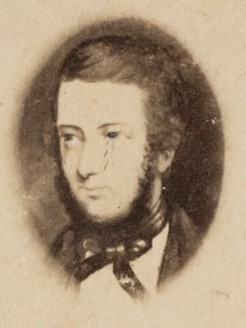
by Cathy Jones (2020)
Development of the residential district commenced with subdivisions of the large land estates. The first major subdivision was the 1867 Redmire Estate, a subdivision of land originally granted to James Wilshire.
The large portion of the suburbs of Strathfield and Strathfield South are built on the original Crown land grant made to James Wilshire in 1810. Wilshire’s grant measured 570 acres (2.3 km2) and was bounded at its southern boundary by the Cooks River, northern boundary by Redmyre Road, at east by The Boulevarde and Coronation Parade and at west parts of Chalmers Road. The land was known as ‘Wilshire’s Farm’, though there is little evidence that the land was developed.
This estate was the Wilshire 1810 grant, which was renamed the Redmire Estate, when transferred to Samuel Terry in 1824. The land remained in Terry’s estate after the deaths of Samuel in 1838 and his widow Rosetta in 1858. Challenges of Terry’s bequests were subsequently challenged in court by members of the family and in 1866, by order of the representatives of the residuary estate of Samuel Terry, the 570 acres of the Redmire Estate was advertised for sale as one lot to be sold at public auction by Richardson & Wrench[1].
The 1866 advertisement notes the land name of ‘Redmire Estate’ Burwood, also known as Wilshire’s Farm, but notes there is no occupants save one cottage and garden on Liverpool Road occupied by ‘the man in charge’[2].
The estate was advertised as ‘an extraordinary opportunity for speculative purchase … as the property occupies a very favourable position for subdivision’, positioned halfway between Burwood and Homebush Railway stations, with extensive frontage to Liverpool Road and suitable for villa sites and garden or orchard cultivation[3]. The advertisement also mentions the Cooks River ‘a beautiful freshwater stream’ and close to the Village of Enfield with ‘its pretty rustic church, schoolhouse, and parsonage’ and the ‘large quantity of timber’ which could raise a considerable sum per acre[4].
In October 1866 the land was reported as sold ‘the Redmire Estate (570 acres), on the Liverpool Road, parish of Concord, for £2850’[5]. The land was sold to William Whaley Billyard, a solicitor and former Crown Solicitor of NSW (c.1850-1859). A subdivision plan was prepared by Ferdinand Reuss Jnr, which divided the land into 73 allotments ranging from 3-13 acres each with frontages from 4-8 chains to Station Road, Railway Road (now Albyn Road), Homebush Road, Liverpool Road, Water Street, Dean Streets, Redmire Boulevarde (former name of The Boulevarde) and Punchbowl Road (now Coronation Parade).
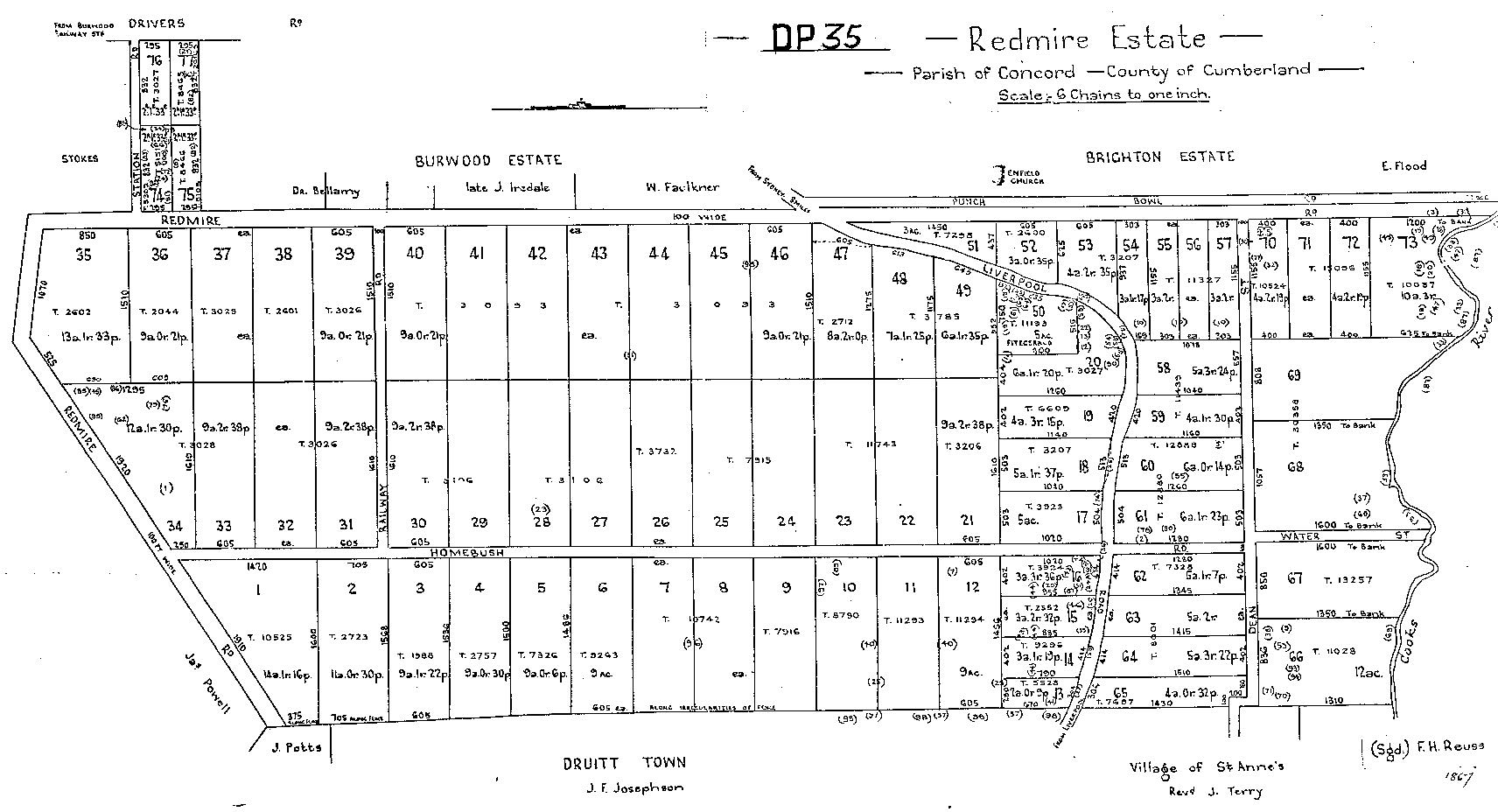
The advertisement for the Redmire Estate appeared in the Sydney Morning Herald on 28 September 1867 and stated:
THE REDMIRE ESTATE OF 603 ACRES, BURWOOD.
AS RECENTLY SUBDIVIDED INTO BLOCKS, of from 3 to 13 acres, distant a little more than QUARTER OF A MILE FROM THE BURWOOD STATION, extending across to the village of Enfield on the Liverpool Road, to both sides of which it has an extensive frontage, and terminating to the southward with a FRONTAGE OF UPWARDS OF THREE QUARTERS OF A MILE TO COOK’S RIVER. Distant by the Main Road only 8 miles from Sydney.
THE VERY HIGH PRICE NOW ASKED for building lands in the neighbourhood of any of the Railway Stations at all within easy access of the city, and THE PRACTICE OF SELLING THEM BY THE FOOT, so much followed, have compelled all but the very wealthy, who desire after the labour and toil of the day to escape from the smoke and dust of the city, TO CONTENT THEMSELVES WITH A MERE ALLOTMENT scarce large enough for a town house. This most undesirable result has already manifested itself at the more favourite localities along the line, and it must eventuate in the total destruction of those advantages which all persons look fo in a country residence.
To do away with this growing evil, the proprietor of THE VERY BEAUTIFUL ESTATE OF REDMIRE has recently caused it to be most carefully surveyed, intersected by roads of access, and laid out in blocks, affording ample SPACE FOR COUNTRY RESIDENCES WITH GARDENS, shrubberies, orchards, &c. With a view to ascertain the adaptability of the land for the purposes of garden and orchard culture, the property was recently inspected by a gentleman eminently skilled in THE CULTIVATION OF THE VINE AND ORANGE, and the result of such examination was the discovery of a RICH VIRGIN SOIL OF l8 TO 24 INCHES DEEP in almost every spot that was opened up. As the general character of the country is gently undulating, it affords the GREATEST NATURAL FACILITIES FOR DRAINAGE, an advantage which cannot be too highly estimated, and to the absence or neglect of which sanitary provision, ma be attributed the early decay of some of our finest orangeries and orchards.
To a largo extent throughout the Estate THE TIMBER HAS BEEN PRESERVED, thus securing on the spot one of the most costly materials for effecting improvements ; providing also where required BELTS OF TREES FOR THE PROTECTION of young plantations, and contributing by the abundant of many of our most beautiful native shrubs to the rapid formation of ornamental grounds.
The very large frontage to Cook’s River PROVIDES AN AMPLE SUPPLY OF WATER for the whole estate, and in order that all may share In this advantage alike ROADS OF ACCESS TO THE PERMANENT WATERS have been carefully marked off from all portions of the estate.
THE PROPERTY ABOUNDS IN BEAUTIFUL BUILDING SITES, so that intending purchasers may here secure ALL THE ADVANTAGES OF A COUNTRY HOME, with ample space for improvements PROTECTED FROM THE INQUISITIVENESS , of a too close neighbourhood, and all within a FEW MINUTES DRIVE OF THE CITY BY RAIL. OBSERVE-TITLE UNDER TORRENS ACT. TERMS -Two-thirds of the purchase money may remain secured upon the several purchases for a term of years’ by way of mortgage.
J.V. GORMAN and MILLER have been Instructed by W.W. BILLYARD, Esq., to sell by public auction, at their Land Sale Rooms, No. 183, Pitt-street, on TUESDAY, 22nd October, at 11 o’clock THE VERY BEAUTIFUL ESTATE of REDMIRE, As recently surveyed and subdivided into BLOCKS of FROM 3 to 13 ACRES EACH, with frontages of from 4 to 8 chains to the following roads and streets :
- STATION ROAD. 66 feet wide
- RAILWAY ROAD, ditto
- HOMEBUSH ROAD, ditto
- LIVERPOOL ROAD, ditto
- WATER and DEAN STREETS, ditto
- REDMIRE ROAD, 100 feet wide.
The 1867 advertisement of the subdivided Redmire Estate emphasised its potential for building country residences and its proximity to rail access:
‘the property abounds in beautiful building sites …all the advantages of a country home … ample space for country residences with gardens, shrubberies … abundant beautiful native shrubs …available timber’ and located ‘few minutes drive of the city by rail’ [6]
The Redmire locality became incorporated under the name of ‘Strathfield’ (the residence of John Hardy, a City jeweler) on June 2, 1885, when local government was formed. The original areas of the new Strathfield Municipality included Redmire, Druitt Town [now Strathfield South] and Homebush.
Footnotes
[1] Advertising (1866, October 19). SMH, p. 7.
[2] ibid
[3] ibid
[4] ibid
[5] Mercantile and Money Article (1866, October 20). SMH, p. 8.
[6] Advertising (1867 September 28) SMH, p10
