By Cathy Jones (2026 updated)
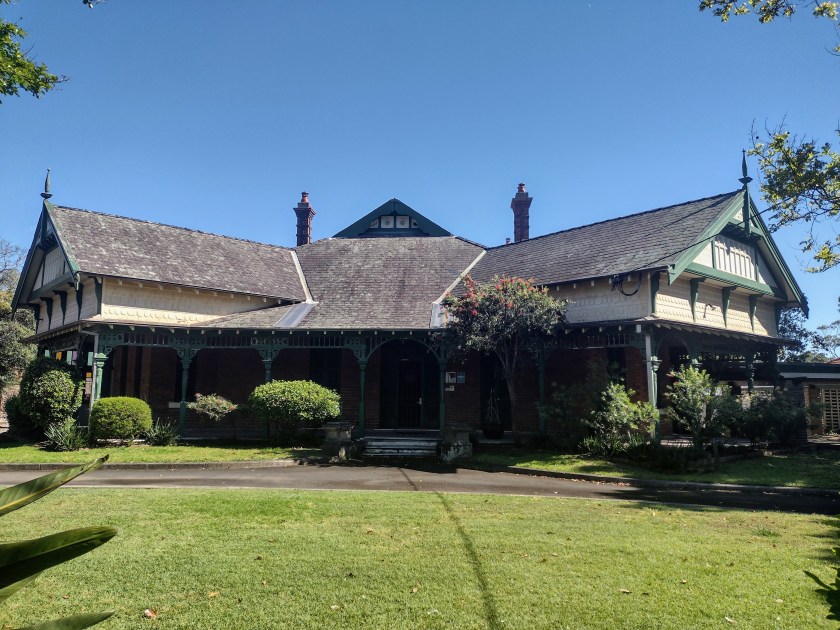
‘Arnottholme’ is located at 65-69 Albert Road Strathfield and is a Federation style house. It was built in 1900 for its owner William Arnott, founder of Arnott’s Biscuits, Australia’s largest business company. The house first appeared in the 1901 Sands Directory as occupied by William Arnott. The house was formerly numbered 49, but was last renumbered in 1947. The house has been known as ‘Arnottholme’, ‘Lodore’, St Andries, ‘Urara’ and ‘Cathona[1]’
The house was built on a large site with a frontage of about 140 feet and is a single storey brick symmetrical Federation style house with a slate roof and gabled projecting wings. The building features elaborate timber detailing to the verandah with balustraded valance, turned timber posts, tessellated tiles and French doors. A ridge gablet has decorative timber work and timber finial. Shingled gables, coloured glass to the verandah, brick chimneys and a mature garden are important features[2].
65-69 Albert Road is located on the original Thomas Rose grant of 1793. The land passed to Edward Powell and by the 1880’s was generally owned by William Russell. In October 1888, six acres in the northern part of Russell’s land was acquired by the President and Fellows of Camden College, with the intention of building a theological college in Strathfield. An additional five perches fronting Homebush Road was added from the Frederick Meredith 1793 grant, thereby the land fronted Albert Road, Homebush Road and Beresford Road.
However, due to 1890’s Depression, plans were withdrawn and the College proceeded with subdivision of the land, which was then offered for private sale in 1898. This subdivision included properties on Albert Road [north-side], Homebush Rd and Beresford Road [south side]. The resultant houses built on this subdivision became a prominent and unified area of high quality Federation style housing. One of these homes was 65-69 Albert Road, the home of William Arnott, founder of Arnott’s Biscuits.


William Arnott (1822-1901), a Scottish migrant and baker, built his business from a single small bakery into major biscuit business. After suffering many business and personal setbacks, he established a successful bakery in 1865 in Newcastle, NSW. The business continually expanded and began shipping its products to Sydney and other regions, outside of Newcastle. To meet demands, Arnott opened a small factory in Forest Lodge in Sydney in 1894 though longer term plans were being developed to build a large factory with access to rail and roads. Eventually, a large site at Homebush was selected in 1905 and the factory built and opened in 1907-1908.
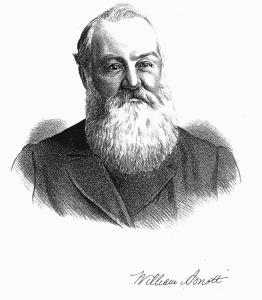
Arnott was active in philanthropic work supporting the YMCA and Salvation Army and a devout member of the Wesleyan Church (Methodist Church). Following the death of his wife Monica Sinclair Arnott in 1865, he remarried Margaret Maclean Fleming Arnott.
In 1894, Arnott took his sons into partnership to take over the day to day management of the business as he moved towards his eventual retirement in 1889 and his move to Strathfield[1]. One of his sons, John Maclean Arnott, had already established residency in Strathfield in 1895 upon his marriage to Adeline Hardy, daughter of jeweller John Hardy, owner of ‘Strathfield House’[2].[3] In the same year, his daughter Madge married Dr George Mander Jones, grandson of retailer David Jones, and resident of Strathfield.[4]
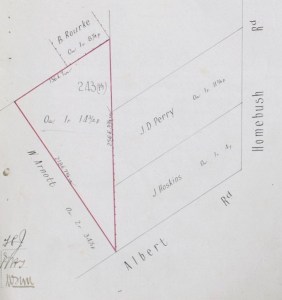
William Arnott moved to Strathfield in 1899, following retirement from the business[5]. He purchased three land lots from the subdivision of the former Congregational land in June and July 1889. The first house he built was ‘Waratah’ (now 37 Homebush Road), which was built in 1899 and named after the suburb Waratah in Newcastle. Arnott lived there with his wife Margaret until the house ‘Arnottholme’ (now 65 Albert Road) was completed in 1900[6]. ‘Waratah’ was then owned his daughter Janet Ducman Perry. ‘Arnottholme’ was built on two lots, which created an irregular piece of land. ‘Waratah’ and ‘Arnottholme’ shared a boundary fence.
The Strathfield Council Heritage Inventory Sheet (1986) states that Arnott designed the house himself and died before it was completed in 1901, but both statements are unlikely to be accurate[7].
It is more likely that Arnott engaged an architect to design ‘Arnottholme’. Arnott is noted in the 1901 Sands Directory as the occupant of ‘Arnottholme’ and it was also widely reported that he died at ‘Arnott Holme’ in July 1901[8]. Arnott was buried in the Wesleyan section of Rookwood Cemetery.
After the death of Arnott’s widow, Margaret, in 1902, ownership transferred to Florence Johanna Arnott, of Homebush (who married John Stevenson in 1904) in November 1902. During her ownership, the house was rented. Horace Allard was the tenant from c.1903 to c.1907 and renamed the house ‘Lodore’. From c.1908 to c.1913, the house was tenanted by John See, who renamed the house ‘Urara’. During See’s occupancy, ownership transferred in October 1910 from Mrs Stevenson to her sister Janet Ducman Perry (nee Arnott), wife of James Simpson Perry of Sydney, agent.
In 1913, Mrs Perry sold the property to Ebenezer Richard Hall, of Aberdeen, grazier, who was the occupier until c.1918. The house was rented to H Gordon Jackett c.1919, owner of Jackett’s Flour Mills and Member of NSW Parliament. In 1920, the property was sold to Arthur John Cozens, of Strathfield, tobacco merchant of the British-American Tobacco company. Cozens renamed the house ‘St Andries’ and remained its owner until 1945. Cozens was the father of Royston Cozens, who married tennis player Daphne Akhurst. He later lived at 23 Newton Road Strathfield.
In 1945, the property was transferred by Cozens to Mary Delany Mol of Dover Heights, wife of Franciscus Bernardus Mol, Canteen Officer, Royal Dutch Merchant Navy. Mrs Mol was the owner until 1949, when the house was transferred to Charles Hanna, manufacturer.
In 1954, the Department of Education acquired this property for the purposes of establishing a public special needs school[9]. In the 1970s, a purpose built school was built in Chalmers Road Strathfield and the school moved. The property was then used by TAFE until 2024, when the property was sold for private use.
In 1954, the house was sold to the NSW Department of Education for £12,000 for the purposes of establishing a school for children with disabilities. The school was later transferred to a new site in Chalmers Road Strathfield. The property was occupied by the Department of Education as a TAFE Campus until its sale to a private owner in 2022.
Footnotes
[1] Mander Jones, (1969), William Arnott, Australian Dictionary of Biography
[2] Weddings. (1895, October 26). The Sydney Mail and New South Wales Advertiser, p. 845.
[3] Family Notices (1897, January 8). The Sydney Morning Herald, p. 1.
[4] Social (1895, March 19). The Sydney Morning Herald, p. 6.
[5] Mander Jones, (1969), William Arnott, Australian Dictionary of Biography
[6] Sands Directory
[7] Fox & Associates (1986), Strathfield Heritage Study, ‘Strathfield Education Centre’ Inventory Item no. 126.
[8] Funeral W Arnott (1901), Sydney Morning Herald
[9] School for Backward (1954, November 7). Truth, p. 43.
References
Department of Valuer-General, Municipality of Strathfield, Valuation Lists
Family Notices (1897, January 8). The Sydney Morning Herald (NSW : 1842 – 1954), p. 1. Retrieved August 20, 2022, from http://nla.gov.au/nla.news-article14083461
Fox & Associates (1986) ‘Strathfield Education Centre’ Inventory Item no. 126, Strathfield Heritage Study
Fox & Associates, 1986, Strathfield Heritage Study, ‘Landmark Tree 71/69 Albert Road’, Inventory Item no. 127
Funeral of the late Mr. W. Arnott, Sen. (1901, July 25). The Sydney Morning Herald, p. 5. Retrieved August 21, 2022, from http://nla.gov.au/nla.news-article14399316
Death of Mr. W. Arnott (1901, July 23). Australian Star, p3
Digby, E (Ed.) (1899) ‘William Arnott’, Men of Mark Vol. II, Charles Maxwell, Victoria Chambers, Elizabeth Street, Sydney.
Kemp & Johnson (2003), Strathfield Heritage Review, 2003
Mander-Jones, Phyllis, (1969), ‘Arnott, William (1827–1901)’, Australian Dictionary of Biography, National Centre of Biography, Australian National University
LandArc Landscape Architects, Strathfield Council Register of Significant Trees, 1985
NSW Land Registry
Radi, Spearitt, Hinton (1979), Biographical Register of the New South Wales Parliament 1901-1970, ANU Press.
School for Backward (1954, November 7). Truth, p. 43. Retrieved August 20, 2022, from http://nla.gov.au/nla.news-article168409500
School to help retarded (1950, February 13). The Daily Telegraph, p. 4. Retrieved August 20, 2022, from http://nla.gov.au/nla.news-article248992470
Social. (1895, March 19). The Sydney Morning Herald, p. 6. Retrieved August 20, 2022, from http://nla.gov.au/nla.news-article13985485
Strathfield Council Valuations Lists
Sands Sydney Directory published by John Sands until 1932
Weddings. (1895, October 26). The Sydney Mail and New South Wales Advertiser (NSW : 1871 – 1912), p. 845. Retrieved August 20, 2022, from http://nla.gov.au/nla.news-article162674791
Wise’s Post Office Directory
