By Cathy Jones (2026)
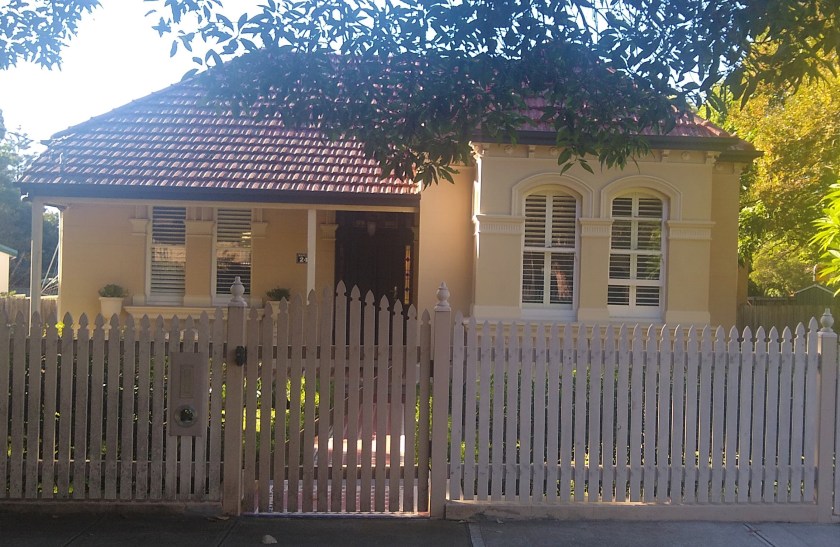
‘Chester’, 24 Meredith Street Homebush is a single storey Victorian Italianate house. It is one of a four similarly designed houses located 18-24 Meredith Street, built by local builder John Waugh from 1889-1891. It is located on the 1878 Village of Homebush Estate and was built in 1890. The house first appears in 1891 Sands Directory for John Stormer. From c.1906, it was named ‘Chester’ in the Sands Directory. This house was originally numbered 16 Meredith Street and was renumbered 24 Meredith Street Homebush in 1958.
Meredith Street Homebush is located within the site of various 1793 land grants offered to a group of free settlers in an area known as Liberty Plains by the NSW Colonial Government anxious to secure a food supply for the growing colony. The land proved difficult to farm and the settlers abandoned farming activity and moved from their land. Eventually, this land and other land located in the current day Homebush West and Homebush (both sides of the railway line) was regranted to Simeon Lord in 1803 and eventually came under the ownership of James Underwood and became part of the large ‘Underwood Estate’. In 1878, a portion measuring 306 acres located south of the railway line, was subdivided for residential development and marketed as the ‘Village of Homebush’. This subdivision created Burlington Road, Beresford Road, Abbotsford Road, Bridge Street, Coventry Road, Meredith Street, Homebush Crescent (later The Crescent) and Bellevue Street (later Homebush Road).
Alexander W S Gregg was a resident of Homebush and Principal of Richardson & Wrench, auctioneers and estate agents. Gregg was an early purchaser of land from the 1878 Village of Homebush Estate. In October 1889, Gregg sold land to John Waugh, a builder from Annandale, purchased land from Alexander W S Gregg.
To finance the land acquisition and building of the house, a mortgage was held over the property. The mortgagees were Florrie Mary Wiseman, Frank Wiseman Doak, Edward Henry Rogers and Andrew James Doak. Rogers is noted on Council valuation records including 1896-97, 1903-05 and 1907 as the owner, however the registered owner of the property was Waugh.
It is assumed that Waugh built and developed the properties to sell or lease. Little is known about Waugh, as research reveals that several builders with the same name were located in the Inner West of Sydney. Searches of newspapers and registers have failed to reveal other information which would assist in accurately identifying the correct person and his personal circumstances. However, it is known that Waugh remained the owner until 1911, when the mortgagees exercising power of sale sold the house to Harold Worrall. During the period of Waugh’s ownership, the house was continually rented, usually for short periods. One of the tenants was John Price, of Kite & Price Timber Merchants Homebush from c.1903-05. Price was an Alderman on Strathfield Council 1902-1920 and Mayor of Strathfield 1906-07
Harold Worrall (1898-1965), a draughtsman of Strathfield, was the owner of ‘Chester’ from 1911 to 1921. According to the 1915 electoral roll, Harold Worrall lived in this house with Caroline Worrall and John Worrall, of ‘independent means’. Caroline and John Worrall were his parents. He married Edith Hemsworth in 1916.
In 1921, ownership transferred to John Henry Hopman (1871-1945) and his wife Jane (usually known as Jennie) Siberteen Hopman (1875-1962) as joint tenants. John Hopman was a retired teacher and former headmaster of Rosehill Public Primary school. John and Jennie Hopman were the parents of Harry Hopman (1906-1985), a renowned tennis player and coach. Hopman resided in this house as a youth and reputedly continued to live in this house until his marriage in 1934 to tennis player Nell Hall. Hopman’s brother, John Henry Hopman (1904-1992), was a manufacturer’s agent and is profiled in Notable Citizens of Sydney 1940 as residing at the Meredith Street house. Tennis courts were once located at the rear of property. In 1961, the courts were subdivided from the properties and sold, creating a new residential lot on Broughton Road. The courts were reputedly used by Harry Hopman for social tennis, practice and tennis coaching. In 1961, land at the rear of 24 Meredith Street with Broughton Road frontage was sold.
Harry Hopman was a noted player and won many titles, however he is best known as captain and coach of 22 Australian Davis Cup teams. Hopman coached the Australian Davis Cup Team to 16 wins between 1939 and 1967, with players such as Frank Sedgman, Lew Hoad, Ken Rosewall, Rod Laver, Neale Fraser, John Newcombe, Fred Stolle, Tony Roche, Roy Emerson, Ashley Cooper, Rex Hartwig, Mervyn Rose, and Mal Anderson. Harry Hopman was also a journalist, providing sporting commentary. After World War II, this became his career until he recommenced tennis coaching. He moved to the United States in 1969 and established a teaching academy. Some of the players he coached included John McEnroe and Vitas Gerulaitis.
In the late 1950s, Strathfield Council named a street in Chullora, Hopman Crescent. It was one of three streets named for sporting identities from the Strathfield district, the others were athlete Marlene Matthews and cricketer Alan Davidson. Unfortunately, Hopman Crescent was built on land which has since been consolidated and the street abolished.
Ownership of the property transferred solely to Jennie Hopman in 1946, after the death of John Henry Hopman. Jennie Siberteen Hopkins died in 1962 at the age of 86 and is buried with her husband, who died in 1945, in the Catholic Mortuary at Rookwood Cemetery. In December 1963, the property was sold by John Henry Hopman (executor of estate of Jennie Hopman) to Frank and Frances Corsi, building contractor for £5500.
References
Births, Deaths and Marriages Registry (NSW) at http://www.bdm.nsw.gov.au
Department of Valuer-General, Municipality of Strathfield, valuation lists
Harry Gordon, ‘Hopman, Henry Christian (Harry) (1906–1985)’, Australian Dictionary of Biography, National Centre of Biography, Australian National University, https://adb.anu.edu.au/biography/hopman-henry-christian-harry-12656/text22807, published first in hardcopy 2007, accessed online 11 April 2026.
Notable Citizens of Sydney (1940) John Henry Hopman
NSW Land Registry
Sands Sydney Directory, published by John Sands (1889-1932)
