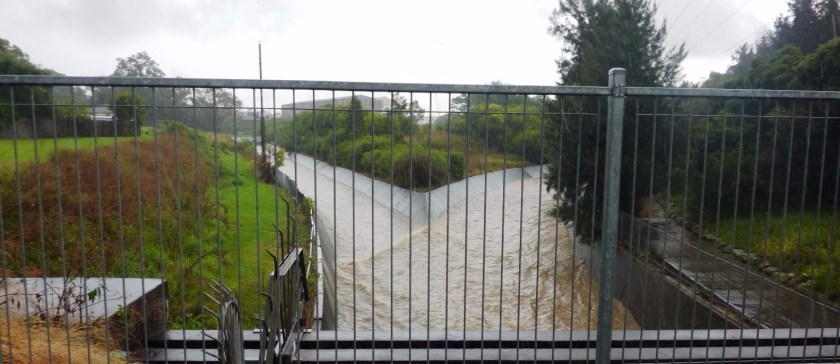
The Cooks River at Strathfield is located in the upper reaches of the catchment, where the open river finishes. The course of the natural river was changed and straightened when the river was channelised from the 1940s.
The Cooks River in Strathfield was described by C A Henderson in his recollections of early Strathfield and Homebush as a ‘chain of ponds’ (Henderson, 1923) because the river was located on low lying land and appears as a series of small ponds, waterholes and land depressions, rather than as an open river.
When it rained, the ponds would fill, but then become stagnant water. With sun evaporation, they would empty until another rainfall. The stagnant ponds were a breeding ground for mosquitos, causing frequent outbreaks.
There were many demands, particularly in the 1920s, to concrete the Strathfield section of the Cooks River, mainly to control flooding and mosquitos.
The concrete channelisation of the River commenced by 1943 between Coronation Parade to Water Street in Strathfield South. However, the extensions from Water Street to Freshwater Park were not built until the 1960s, after significant lobbying by Strathfield Council and the Cooks River Valley Association to the former Metropolitan Water & Sewerage Board (now Sydney Water).
To many locals, the Cooks River appears to always be empty. However, during periods of heavy rainfall, water in the river from rainfall and stormwater runoff from catchment land causes water to rise quickly with move with rapid speed.
Prior to the concrete canalling of the river, flooding of the land and deaths by drowning in the Cooks River in the Strathfield area was not uncommon. As a result of storms and heavy rain, water would rise quickly and anything (such as cars, bridges or animals etc) or any person caught in the path of fast moving water could be swept away. Two of the more tragic stories of death by drowning in the Cooks River, involve young children.
On 12 January 1897, three brothers, George Henry Kerslake aged 13, Phillip Kerslake 10, and Stephen Kerslake 8, of Oxford St Strathfield were drowned in a waterhole at Druitt Town. It seems, according to a witness Thomas Morrison, that the boys had disappeared in a waterhole where they had been bathing. The water hole about 9 feet deep and 30 feet wide, near the bend of Cook’s River. The bodies were recovered and it appeared that the eldest boy had tried to save his brothers, but all had drowned.
In February 1935, a fierce storm caused flooding and lightning damage across Sydney, resulting in the death of 12 year old Ronald Gardiner at Cooks River at Enfield. The boy attempting to collect driftwood from the water was swept away by the currents and drowned. It appears that the same storm swept away and destroyed the wooden bridge at Water Street Strathfield South, which crossed the river.
In November 1947, Sydney experienced a violent tropical storm with winds reported of 60 miles (96km) an hour. Two brothers, William Charles Warner (aged 11 years) and John Warner (aged 6), students of South Strathfield Public School, were both drowned in the Cooks River stormwater canal at Enfield. John was swept into the river and his brother drowned trying to rescue his little brother.
References
Barrier Miner (Broken Hill, NSW : 1888 – 1954), Thursday 14 February 1935, page 3
FUNERAL OF CANAL VICTIMS (1947, November 25). The Sun (Sydney, NSW : 1910 – 1954), p. 9 (STUMPS EDITION). Retrieved November 21, 2023, from http://nla.gov.au/nla.news-article230553226
Tragic Drowning Case. (1897, January 16). The Cumberland Free Press (Parramatta, NSW : 1895 – 1897), p. 6. Retrieved November 21, 2023, from http://nla.gov.au/nla.news-article144442173
Henderson C A (1923) ‘Sydney to Homebush 1855’, Royal Australian Historical Society Journal and proceedings Vol. VIII, Supplement.
Sydney Mail and New South Wales Advertiser (1897 January 23), page 161
Discover more from Strathfield Heritage
Subscribe to get the latest posts sent to your email.

Funny what you stumble across on the internet ,lucky there was no malaria happening, fond memories of Strathfield.
LikeLike
I have found a number of newspaper articles from the 1910s and 1920s regarding Strathfield Council campaigns against flies and mosquitos. They adopted ordinances that authorised them to take prosecution action. I also found an article from 1917 which stated that Council also erected great iron replicas (4 feet x 3 feet) of the fly with the warning ‘Kill that Fly, or it will kill you!).
LikeLike
Wow, we were like Singapore before Singapore.
LikeLike
Would love to find an illustration of the iron fly statues, such a bizarre thing to do for such a conservative place.
LikeLike
You may be interested in an earlier drowning case of three brothers George, Phillip and Stephen Kerslake who drowned while going for a swim in one of these water holes of the Cooks River in 1897. They lived in Oxford st, just a short walk away. They were aged 13, 10 and 8 years respectively. The older brother jumped in to try and save the two younger ones.
LikeLike
There are some heartbreaking stories of drowning in the river involving children from the same family. Oxford St is unlikely to be Oxford in Strathfield, do you know the suburb? Cathy
LikeLike
There is an Oxford rd or street parallel to Albert Road. The father worked for the Von der Heyde’s whose mansion was on Albert rd, so I am assuming that that was the street where they lived. Some of the reports in the paper mention another boy with them who ran back to the father to raise the alarm about what had happened.
LikeLike
I lived as a child at the old Royal hotel by the river, & as a teenager attended Strathfield Girl’s High School, across the other side. I remember one day, while trying to take a short cut across a pipeline (fitted with deterrent spikes) to walk to school with my girlfriend, I slipped & fell into the murky water at a point where there was a lot of smelly rubbish etc & was soaked….I went home, showered & took the day off!…….I guess I was one of the lucky ones, though as you can imagine by all the clutter in the river, it was neither deep nor running very fast on that day. It made for an interesting explanation to Mum.
LikeLike
I think the spikes are still there on the silver pipes. Cathy
LikeLike