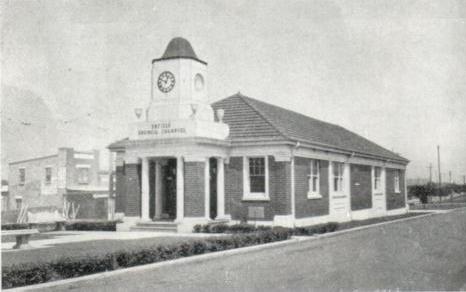
Enfield Council (then known as a Borough) was incorporated on 22 January 1889. The new Council was located on the south of the Burwood and Strathfield Municipalities. The Enfield area extended from Ashfield (east) to Greenacre (west) and was divided into East, Central and West wards. Aldermen were elected to represent each ward. Although geographically large, its population was initially sparse. The least populated of these was the west ward which eventually was merged with Strathfield Council on 1 January 1949.
In the 1877 Grenville Postal Guide only 148 householders were recorded in Enfield, primarily farmers, market gardeners, tanners, woodcutters, dairymen, potters, fencers, carpenters and labourers. However, by 1888, the population of Enfield had reached 1500 and local residents submitted a petition to the NSW Governor requesting the formation of a municipality. At the time of incorporation in 1889, there were 158 houses in the Central Ward, 64 houses in the West Ward and 128 houses in the East Ward. The boundary was later realigned at west to include part of Greenacre.
The first Enfield election was held on 23 March 1889 and elected the following as Aldermen: Thomas Hodson, Hugh Cadden, Frederick H. Lipscomb, Herman H. Groth, Thomas S. Richardson, George Westbrook, James Eve, William Foy and Luke West. The first Mayor was James Eve, later a Member of the NSW Parliament and and the Council Clerk Edward A. Pyman.
The boundaries of Enfield Council, according to the 1890 Sands Sydney Directory, were described as ‘From the corner of Greenhill Street and Liverpool road; thence southerly along the west side of Greenhill Street to the George’s River road; thence westerly along the north side of the George’s River road to the Burwood road; thence southerly along the west side of Burwood road to Cook’s river; thence along the north bank of Cook’s river to the bridge on the Liverpool road to the point of commencement of Greenhill street’.
Enfield Council rented premises in Tennyson Parade at first, moving to a new Town Hall on the corner of Liverpool Road and The Parade in 1893, remaining there until new Council Chambers were built on the corner of Liverpool Rd and Coronation Parade in 1930. The former Enfield Council Chambers are heritage listed on Strathfield Council’s Local Environment Plan. The Enfield War Memorial is located at the front of the Chambers and was opened in 1924.
In 1947, the NSW Government legislated the ‘Greater Sydney Plan’, which advocated the amalgamation and reduction of 67 shires and municipalities in the County of Cumberland to 39. Many small Councils were amalgamated at this time such as Rookwood with Auburn Council, Mascot with Botany Council, Vaucluse with Woollahra Council and Homebush with Strathfield Council. Enfield Municipality was split with the west ward of Enfield Council joining Strathfield Municipality and the central and east wards joining Burwood Municipality.
A council election was held on 12 November 1948 of the new United Area of Strathfield Council, which also included the west ward of the former Enfield Council. The Council was divided into two wards – First Ward and Second Ward. The First Ward was composed of 12 Aldermen and included the Strathfield and former Homebush council areas. The Second Ward was composed of 3 Aldermen from the Enfield Council area. Former Enfield Aldermen Allan Stanley Hanson, James Clarence Morgan, William James Weiss were elected in the 1948 election.
The last meeting of Enfield Council was held in December 1948 and on 1 January 1949 the western ward of Enfield Council was formally amalgamated with Strathfield Council.
Related information
