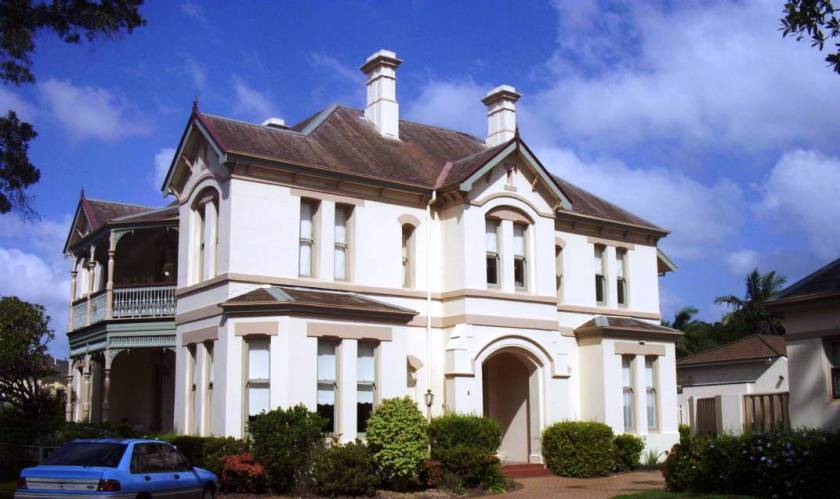
Victorian Period in Strathfield c.1860s – c.1890s
by Cathy Jones
The Victorian architectural period coincides with the first wave of residential development in Strathfield from the late 1860’s. This roughly occurred during the reign of Queen Victoria (1839-1901). The Victorian period was characterised by unprecedented affluence, success and economic prosperity, notably wealth generated by agriculture (wool and wheat) and the discovery of gold in Victoria and NSW. Profits generated from land speculation and investment, pastoral interests and manufacturing translated into eclectic architectural styles and interior decoration.
The first wave of residential development commenced in Strathfield around the late 1860s. By 1885, when the Council was formed, Strathfield contained 130 homes. By 1890, 275 homes had been constructed.
The economic prosperity of early residents of Strathfield enabled construction of substantial homes and gardens, many described as mansions or ‘country-style’ estates. Many Victorian style mansions still exist in Strathfield today, though most are situated on smaller allotments of land that when first built, due to subdivision of their grounds. Some have been readapted for non-residential uses such as schools.
The early 1890s saw the end of the ‘long economic boom’ as the adverse conditions of the economic depression set in, which lead to the end of the ‘Victorian’ architectural period.
The Woodward Avenue Heritage Conservation Area, including parts of The Boulevarde and Albyn Road Strathfield, features many examples of Victorian architecture of the late 1880s in Strathfield. There are also excellent examples of in streets such as Redmyre Road Strathfield, Florence Street Strathfield, Meredith Street Homebush, Abbotsford Road Homebush, Homebush Road and Albert Road Strathfield
Articles on the following properties:
- ‘Warragong’ 30 Agnes Street Strathfield
- ‘Agincourt’ Albert Road Strathfield
- ‘Tuxedo’, Albert Road, Strathfield
- ‘Milroy’ Albert Road Strathfield
- ‘Elwood House’ Albert Road Strathfield
- ‘Broughlea’, Abbotsford Road Homebush
- ‘Florenceville’ 44 Abbotsford Road Homebush
- ‘Hawthorne’ 78-80 Abbotsford Road Homebush
- ‘Strathhayne’ 60 Abbotsford Road Homebush
- ‘Wellbeck’ 96 Abbotsford Road Homebush
- ‘Brunyarra’, The Boulevarde, Strathfield
- ’Ethelstone’ Broughton Road Strathfield
- ‘Mount Royal’, Barker Road, Strathfield
- ’Marlborough’ Burlington Road Homebush
- ‘Finchley’ 61 Burlington Road Homebush
- ‘Meyrick’ 82 Burlington Road Homebush
- ‘Royston’ 14 Carrington Avenue Strathfield
- ‘Glen Luna’ 2-4 Carrington Avenue Strathfield
- ‘Edna’ 13 Coventry Road Strathfield
- ‘Verona’ 27 Coventry Road Strathfield
- ‘Verani’ 24 Homebush Road Strathfield
- ’Nereus’ Woodward Avenue Strathfield
- ‘The Braes’ Redmyre Road, Strathfield
- ’Albermarle’ Shortland Ave Strathfield
- ‘Woodstock’, Redmyre Road, Strathfield
References
Apperly, R., Irving, R., Reynolds, P., A Pictorial Guide to Identifying Australian Architecture, Angus & Robertson, 1995
Fox and Associates, Strathfield Heritage Study, Vol. 1 and 2, Strathfield Municipal Council, 1986.
Jones, Cathy., About Strathfield Municipality, 2nd Edition, 2007
Jones, M A, Oasis in the West: Strathfield’s First One Hundred Years, Allen and Unwin, 1985.
Sagazio, C (ed), The National Trust Research Manual, Halstead Press, 2004
Author
Cathy Jones. (c) Cathy Jones 2011

Cathy
How would i find historical information about my house in florence st?
LikeLike
What number?
LikeLike
What is the house number?
LikeLike